Game guide · Wargaming
World of Warships explained: concealment, citadels and what the free version really gets you
Before you read on
This page contains partner links (affiliate links). If you create an account through a link marked “Partner link”, the publisher of this site may receive a commission from the advertiser. The games discussed here are free to download and play, and using our links never changes what you pay.
Commission does not buy a good write-up. Nothing on this page is a review score, a testimonial, or a claim of a guaranteed result, and the drawbacks are listed alongside the strengths. Read our editorial policy.
A naval game in which the enemy is usually a distant smudge, your shells take eight seconds to arrive, and the most dangerous ship on the map is the one nobody has spotted. Here is how the systems fit together — and what the shop is actually selling.
What World of Warships is — and which one you are installing
World of Warships is a team-based online game in which each player commands one historically inspired warship. It launched on PC in 2015 and has been updated continuously since. Like its sister game it is free to download and free to play, funded by an in-game shop.
As with the tank game, the name covers more than one product, and they do not share accounts:
| Title | Where it runs | Notes |
|---|---|---|
| World of Warships (the PC game) | Windows PC | The full game. 12 vs 12 random battles, the complete tech tree and every mode. This guide describes this version. |
| World of Warships: Legends | PlayStation, Xbox, mobile | A separate, streamlined console and mobile game with its own progression, smaller teams and its own account. No cross-play with the PC game. |
A correction to an earlier version of this page
An earlier version of this article described a “10v10” format and claimed cross-play between PC and consoles. Neither is right. PC random battles are twelve a side, and the console game is a separate product with no cross-play. Both have been corrected.
Since 2022 the CIS region has been operated separately by Lesta Games under a different name. In Europe you are playing Wargaming's version.
Download and try it
The client is free, the account is free, and the lower tiers will tell you within an evening whether the slower, longer-ranged rhythm of naval combat suits you.
Play World of Warships freePartner linkPartner link to the World of Warships offer. If you register through it we may earn a commission from the advertiser; it costs you nothing extra and the game remains free to play. How we are funded
Five classes, five completely different games
Ship classes in this game are not variations on a theme. Playing a destroyer and playing a battleship have almost nothing in common beyond the controls.
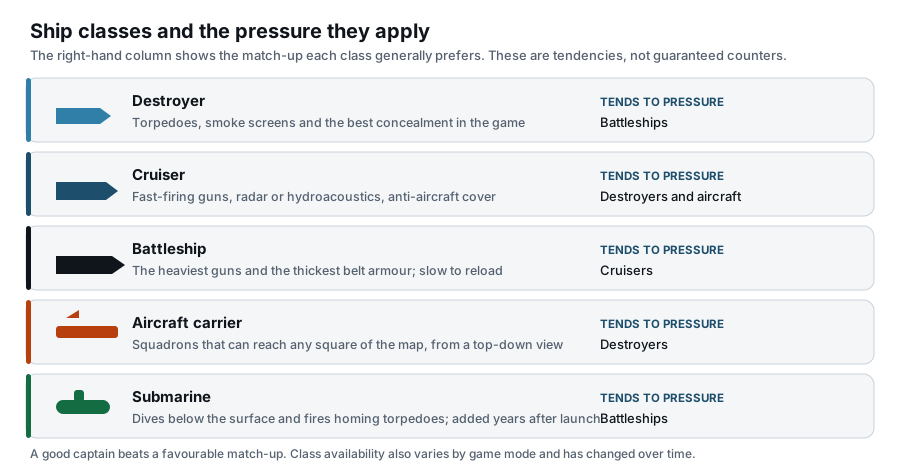
- Destroyers are small, fast, almost unarmoured and extremely hard to see. They carry torpedoes and a smoke generator. They control where the rest of the fleet can safely go.
- Cruisers are the middle ground: guns that fire every few seconds, usable anti-aircraft defences, thin enough armour that a battleship shell will go straight through.
- Battleships hit hardest and take the most punishment, and reload slowly enough that a missed salvo is a real cost. They are the easiest class to survive in and the easiest to play badly.
- Aircraft carriers play a different game entirely, flying squadrons from a top-down view. They can reach any part of the map, which makes them divisive among players.
- Submarines were added to the PC game years after launch and remain the most argued-about class in it.
Concealment is the core mechanic
If you learn one thing about this game, learn this: the range at which you can be seen and the range at which you can shoot are two different numbers, and the gap between them is the whole game.
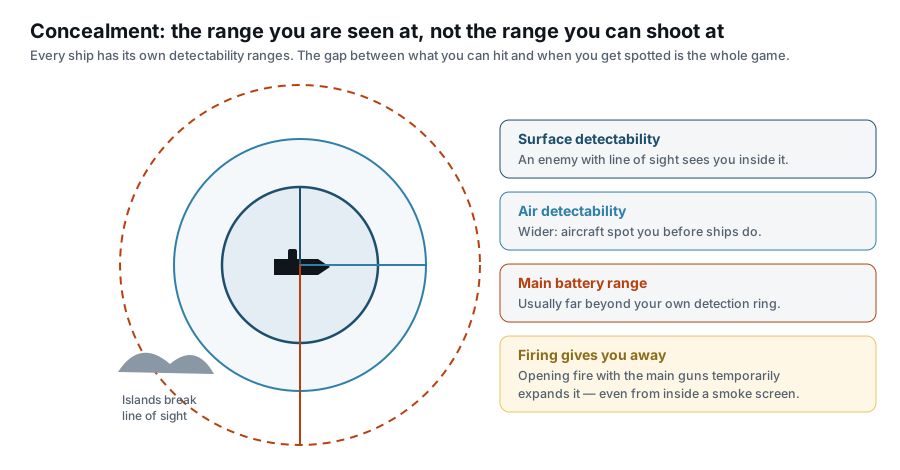
Consequences that surprise new players:
- A destroyer can sit inside your gun range for minutes without being visible to you at all.
- Firing your main battery briefly expands your own detection range, which is why a ship shooting from inside a smoke screen can still be targeted.
- Aircraft see further than ships do, so a carrier or a spotting plane changes the map for everyone.
- Hydroacoustic search and radar consumables can detect ships through smoke and terrain for a short window. Knowing which enemy ships carry them is genuinely important.
Gunnery: why some hits do nothing and others delete you
Shells take real time to travel — several seconds at long range — so you aim where the target will be, not where it is. What happens on arrival depends on the shell and the plate:
- Armour-piercing shells need to punch through armour and detonate inside. Against a thin or badly angled target they can pass straight through without arming, doing almost nothing. Against the right target they hit the citadel — the vital box housing the machinery and magazines — and remove a huge slice of health in one salvo.
- High-explosive shells do modest damage anywhere and can start fires. Fires burn over time and are one of the main ways lightly gunned ships hurt heavily armoured ones.
- Semi-armour-piercing shells, available on some lines, sit between the two.
- Overmatch: a sufficiently large calibre punches through thin plating regardless of the angle it arrives at. This is why the biggest battleship guns ignore the bow armour of ships that would bounce anything smaller.
Angling works here as it does in the tank game. Showing your bow to an enemy battleship makes your belt armour far harder to penetrate; showing your broadside invites a citadel hit.
Torpedoes, fire and flooding
Torpedoes are slow, invisible until they get close, and devastating. They are the reason you should never sail in a straight line for long. Torpedo hits cause flooding, which drains health over time; high-explosive hits cause fires, which do the same. Both are cleared with the damage control party consumable, which then goes on cooldown — so the real skill is choosing when to use it rather than using it immediately.
See it for yourself
Concealment is the mechanic that reads strangely on paper and makes immediate sense the first time a destroyer appears four kilometres off your bow.
Play World of Warships freePartner linkPartner link to the World of Warships offer. If you register through it we may earn a commission from the advertiser; it costs you nothing extra and the game remains free to play. How we are funded
What a battle looks like
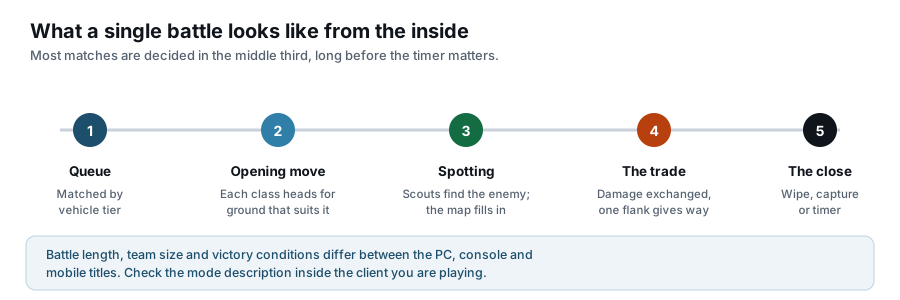
Twelve ships a side, one life each, capture points on the map and a timer. Matchmaking works by ship tier rather than skill, so you will regularly meet ships one or two tiers above yours. When that happens, your job shifts from trading damage to supporting, spotting and holding a flank.
Tech tree, credits and experience
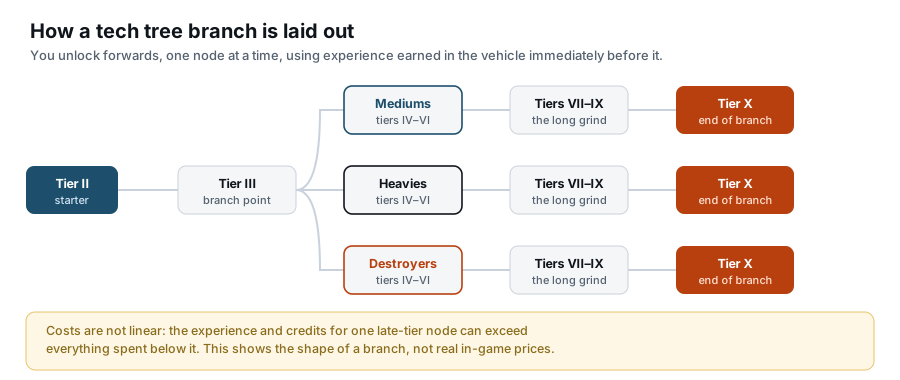
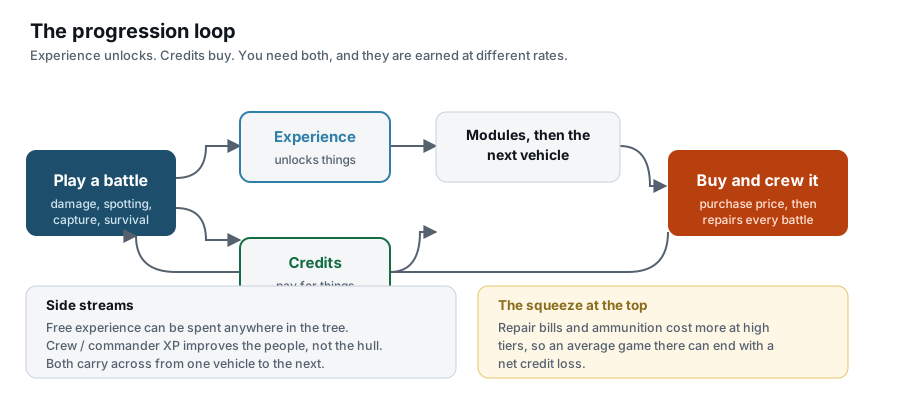
The game runs tiers I to X, with a small number of “super ships” above tier X added some years after launch and unlocked through a separate currency. As in the tank game, experience researches and credits purchase, and high-tier battles have running costs that an average result may not cover.
Is it pay to win?
A correction
An earlier version of this page said the game had “no pay-to-win mechanics” and that “all ships and upgrades can be earned through gameplay”. That was wrong: a substantial part of the premium roster has never had a research path and can only be bought or won in events. The section below replaces it.
- Every tech-tree ship is earnable by playing. No tier X is sold directly, and no module or upgrade is paywalled.
- Money buys progression speed. Premium account time, premium ships with higher credit earnings, and experience boosters all compress the grind.
- A large premium roster is purchase-only. Many premium and special ships are sold in bundles or offered through limited events, and are not available afterwards.
- Balance of premium ships is contested. Wargaming's stated aim is that they sit alongside their tech-tree equivalents rather than above them; specific releases have been criticised and some have been adjusted after the fact.
Our summary is the same as for the tank game: pay-to-progress rather than pay-to-win, with an economy at the top of the tree that makes a premium account feel like the price of playing there comfortably.
What money buys
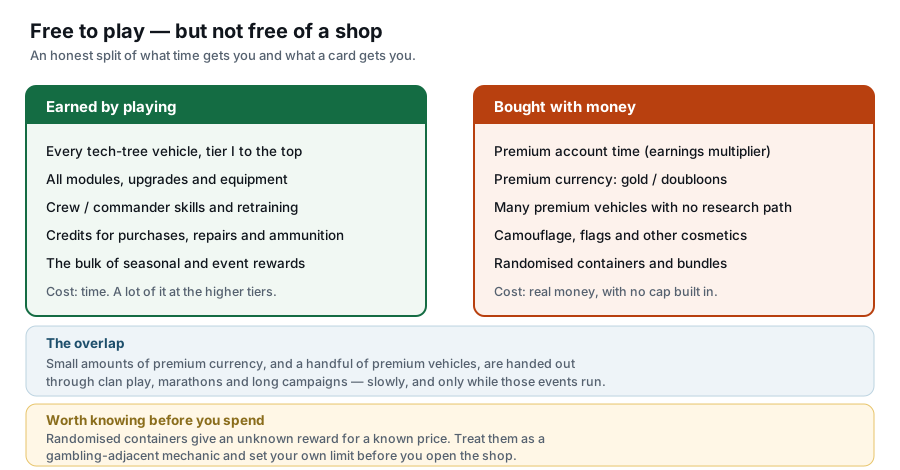
The detail, including your rights as an EU consumer buying digital content, is on what “free to play” actually costs.
Who it is for, and who should skip it
Play it if you like slow, thoughtful, long-range combat, if you enjoy reading a map and deciding where not to be, and if a match that turns on a single decision made four minutes in sounds appealing rather than frustrating.
Skip it if you want fast action — a naval battle can involve long stretches of repositioning — or if the idea of being sunk by something you never saw will annoy you more than it intrigues you. Carriers and submarines are also genuinely divisive; if a class that can reach you anywhere on the map sounds unpleasant, that is a reasonable reason to pass.
Getting started
- Stay in the low and middle tiers while you learn. Ships handle the same and repair bills are small.
- Try one of each class before committing to a line. The classes differ so much that your preference is genuinely hard to predict.
- Learn your own detectability figure for the ship you are in. It is shown in the ship's stats and it governs almost every decision you make.
- Angle away from battleships. Showing your full broadside at range is the single most expensive habit in the game.
More of this in the beginner's guide.
Ready to try it?
Free client, free account, and the lower tiers cost nothing but time.
Play World of Warships freePartner linkPartner link to the World of Warships offer. If you register through it we may earn a commission from the advertiser; it costs you nothing extra and the game remains free to play. How we are funded
Sources and further reading
- Wargaming — World of Warships official site (Europe): worldofwarships.eu
- Wargaming — official wiki and ship statistics: wiki.wargaming.net
- Wargaming — player support: eu.wargaming.net/support
- Wargaming — terms of service, EULA and privacy documents: legal.eu.wargaming.net
- In-game ship statistics, consumable descriptions and current patch notes, which are authoritative for any figure quoted here.
Published 21 September 2026 by Karen Lee, director of publication. Mechanics, prices and class availability change with every update. Where anything on this page differs from the information published by the game's operator, the operator's own information prevails. Found an error? Let us know.